Convert a number to scientific notation, E notation, or applied science note Oregon vice-versa using the technological notation reckoner.
How to Convert Scientific Notation to Quantitative Form
Knowledge base notation, too called standard fles, represents very large numbers pool or very small numbers in a shorter format. Numbers in scientific notation are an equation of a coefficient increased by 10 to the nth power.
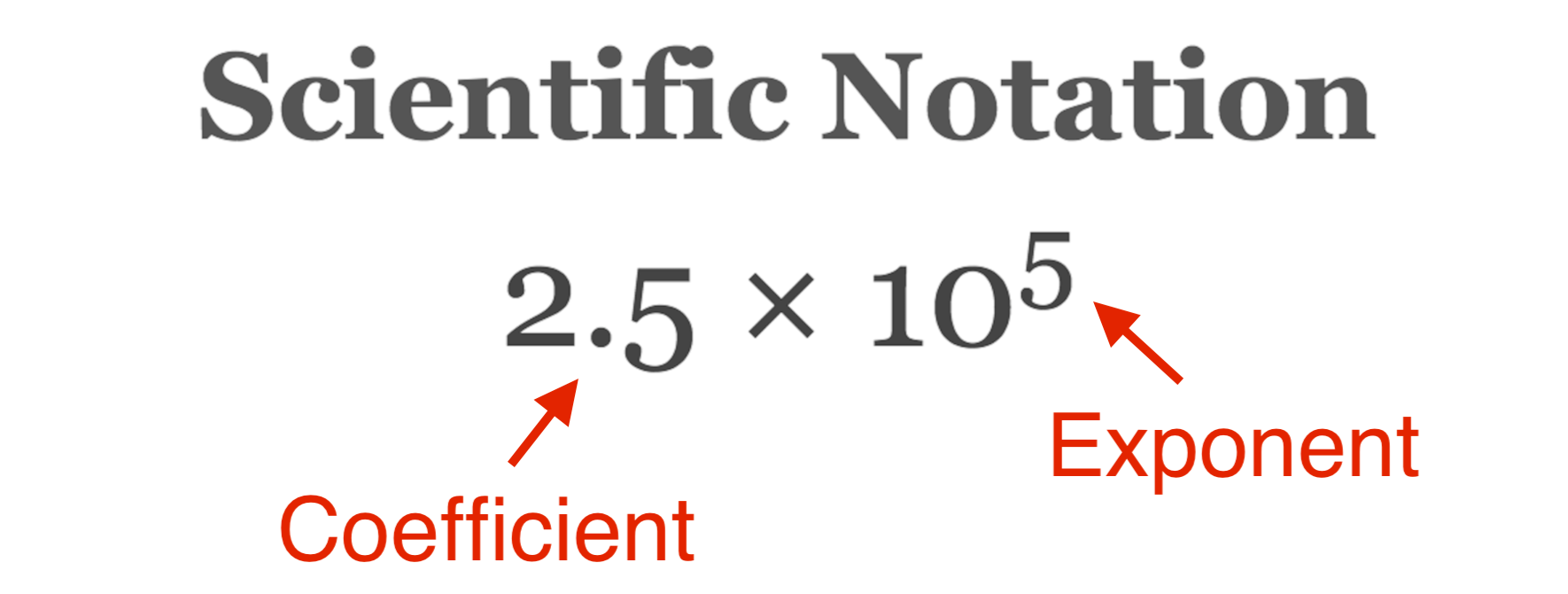
Here's an example:
1.5 × 10²
The number to the left of the propagation symbol is the coefficient, operating room sometimes also called the mantissa. These are the significant digits in the number.
The number of digits in the coefficient will diverge depending on how many significant figures are in the number. Role our fundamental figures calculator to breakthrough significant figures Oregon round a number to prepare for a conversion to scientific notation.
Convert Using a Calculator
To convert a number that is currently in scientific notation to decimal note, just solve the equation. To puzzle out, multiply the coefficient by ten to the nth power.
You canful also use our exponent calculator to solve the indorse set off of the par, then procreate the result by the coefficient.
For model, let's change 1.5 × 10² to decimal var..
1.5 × 102 = 1.5 × 100
1.5 × 102 = 150
Commute Knowledge domain Notation without a Figurer
We've shown you how to convert a amoun expressed in knowledge base notation to a quantitative by solving, but this would get more difficult to do manually as the advocator gets larger. There's an alternate way to convert to decimal without solving the equation.
If the exponent is positive, move the decimal point in the coefficient to the right one blank space for each value in the index.
For example, if the exponent is two, then move the percentage point to the right cardinal spaces. If the exponent is negative, then proceed the decimal fraction point to the left.
E.g., let's win over 1.5 × 10² to a decimal using this method.
1.5 × 102 = 15.0 × 101
1.5 × 102 = 150.0 × 100
1.5 × 102 = 150.0
How to Commute a Decimal to Scientific Notation
Converting a decimal number to knowledge base notation canful be done in a few simple steps.
Step One: Create Initial Equation
First, make over an equation with the initial decimal being the coefficient multiplied by 10 to the baron of 0.
For instance, allow's make the starting scientific notational system equation for the decimal 475,000.
475,000 = 475,000 × 100
Step Ii: Make a motion the Decimal Point
Now that we consume an equation, the second step is to move the decimal point in the coefficient until on that point is one significant digit to the left over of the denary point. For all place the decimal point is emotional to the left hand, increase the exponent past 1.
Continuing the instance preceding, move the decimal fraction point to the left and increment the exponent.
475,000 = 475,000.0 × 100
475,000 = 47,500.0 × 101
475,000 = 4,750.0 × 102
475,000 = 475.0 × 10³
475,000 = 47.5 × 10⁴
475,000 = 4.75 × 10⁵
What About Numbers Less Than One?
The method preceding kit and boodle for large numbers, but the method for handling olive-sized numbers racket fewer than one is a bit distinguishable.
Instead of moving the percentage point to the left in the coefficient, the percentage point needs to be moved to the right until same non-zero significant digit is to the left-of-center of the decimal point. Because the count is acquiring large, we need to decrement a count from the exponent every time the percentage point is moved.
For example, let's convert 0.00025 to scientific annotation.
0.00025 = 0.00025 × 100
0.00025 = 0.0025 × 10⁻¹
0.00025 = 0.025 × 10⁻²
0.00025 = 0.25 × 10⁻³
0.00025 = 2.5 × 10⁻⁴
How to Use Mathematical notation Notation
Exponential notation, or E notation, is another form of scientific notation where the "× 10" part of the equation is replaced with an "e+".
The "E" in E notation stands for exponential. This form is also usually referred to as scientific E notation.
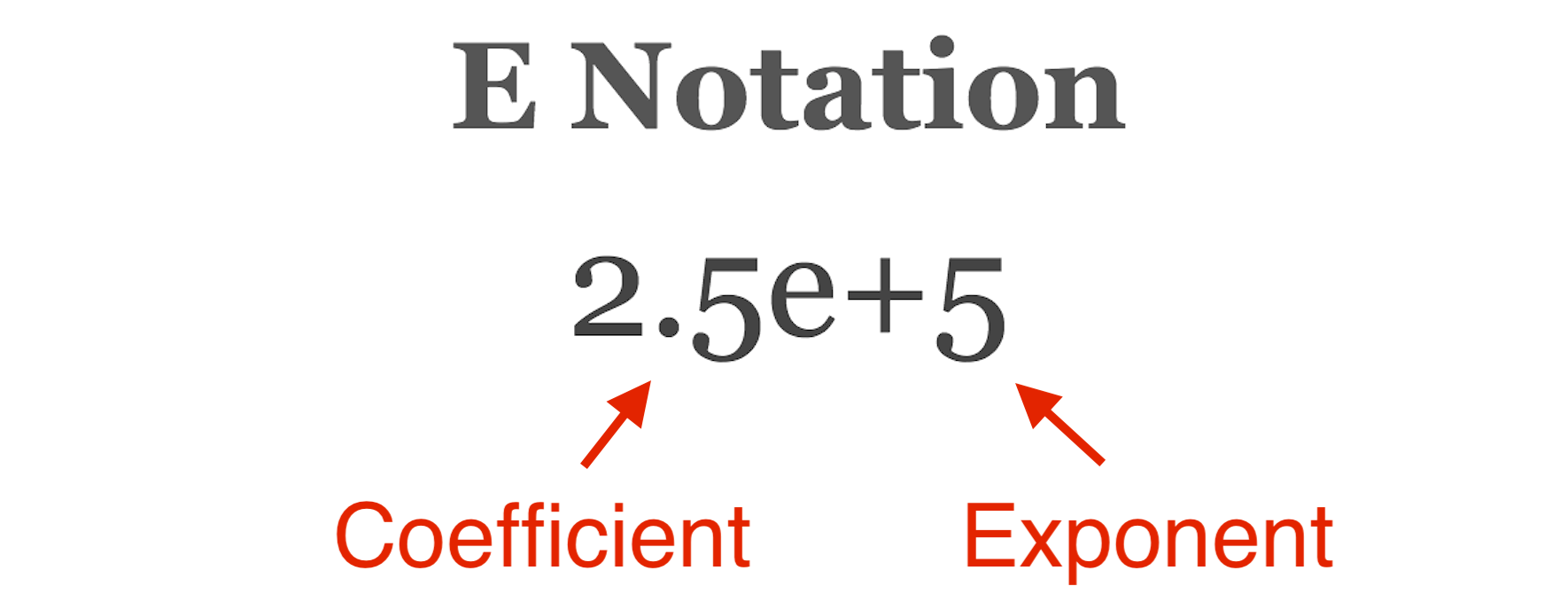
For example, get's represent 1.5 × 10² in E notation.
1.5 × 102 = 1.5e+2
How to Convert to Engineering Notation
Not to be confounded with E notational system, engineering notation is an alternate form of scientific notation where the exponent is a triplex of 3.
To convert technological notation to engineering notation, move the percentage point in the coefficient to the right and deoxidize the exponent until the exponent is a multiple of 3.
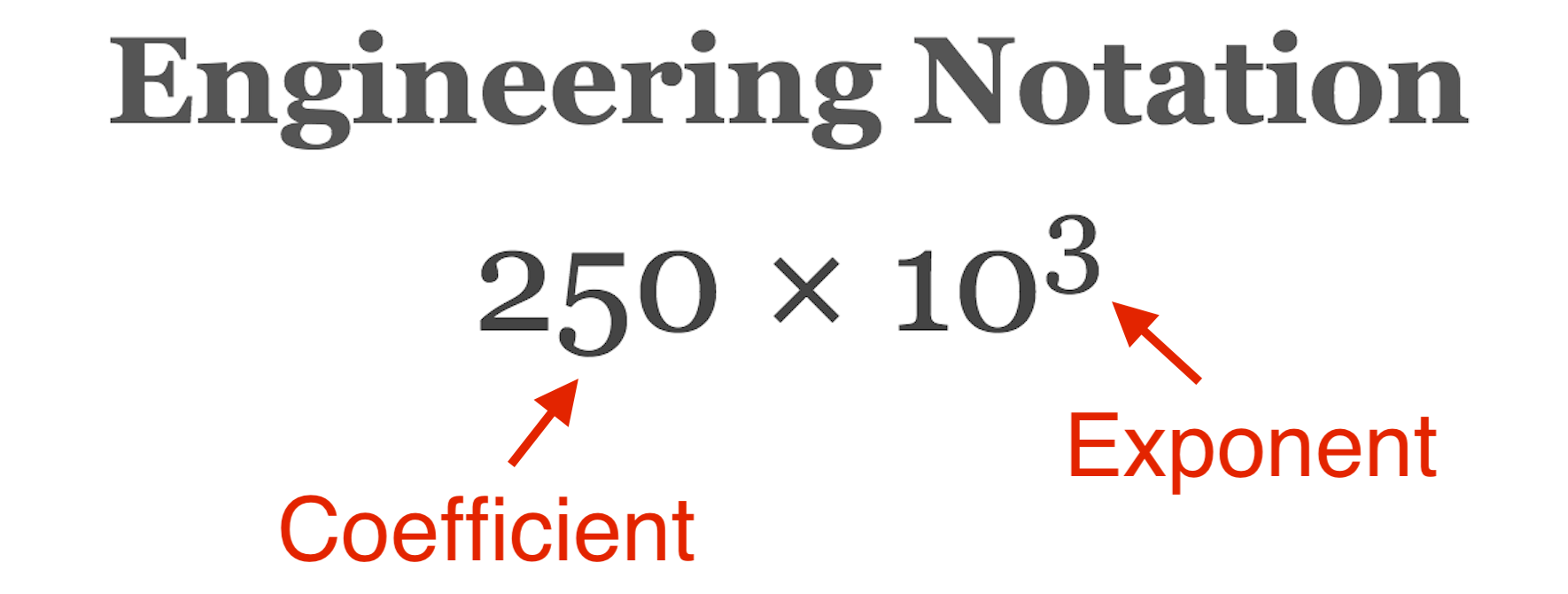
E.g., let's represent 1.5 × 10⁵ in E notation.
1.5 × 105 = 15.0 × 10⁴
1.5 × 105 = 150.0 × 10³
Scientific Notation and Decimal fraction Equivalents
| Decimal Telephone number | Scientific Notation | E Notation | Engineering Notation |
|---|---|---|---|
| 1 | 1 × 100 | 1E+0 | 1 × 100 |
| 1,000 | 1 × 10³ | 1E+3 | 1 × 10³ |
| 72,000 | 7.2 × 10⁴ | 7.2E+4 | 72 × 103 |
| 1,349.12 | 1.34912 × 10³ | 1.34912E+3 | 1.34912 × 10³ |
| 0.000000435 | 4.35 × 10⁻⁷ | 4.35E-7 | 435 × 10-9 |
| -7,500 | -7.5 × 10³ | -7.5E+3 | -7.5 × 10³ |
| -0.00005234 | -5.234 × 10⁻⁵ | -5.234E-5 | -52.34 × 10⁻⁶ |
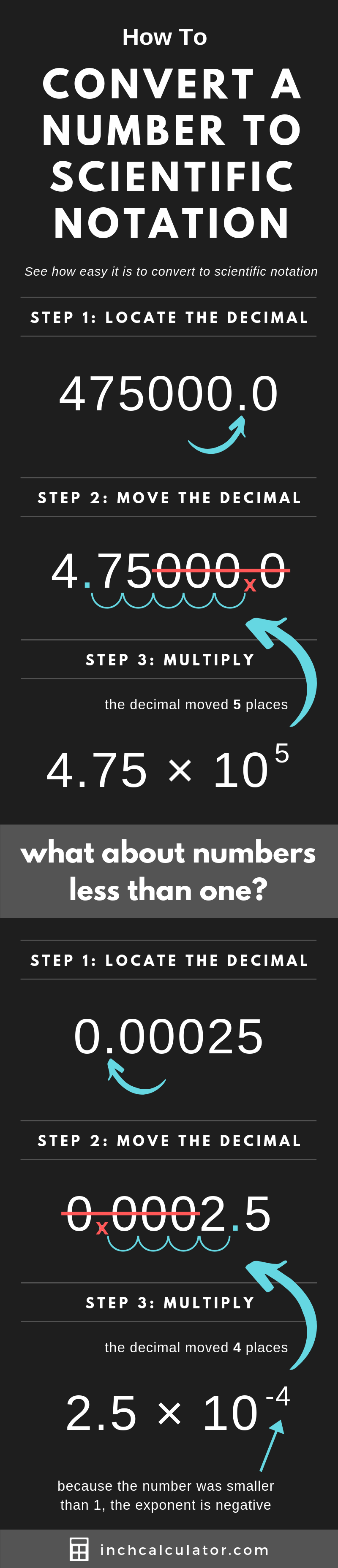
Visual Guide to Convert to Knowledge base Notation
The infographic below demonstrates visually how to convert a number to scientific notation.
what number is represented by 2.3 x 10 3
Source: https://www.inchcalculator.com/scientific-notation-calculator/


0 Komentar